
Ouachita Parole and Probation Compared
Parole and probation can both place an adult under community supervision, but they arise in different ways. Parole follows release from confinement while the sentence continues. Louisiana’s Committee on Parole makes parole decisions, and the Department of Public Safety and Corrections Division of Probation and Parole handles community supervision. Probation comes from a court sentence. It may follow a suspended term, a parish jail term, or part of a split sentence. Neither status means the person remains housed at Ouachita Correctional Center.
The distinction matters when reading a record. A parole certificate or Committee result can support the move from confinement to parole. A probation judgment begins with the sentencing court. An assignment to the Monroe District office is useful proof of a supervision relationship, but it should be read with the underlying decision. Work-release placement is also different. A resident of either Ouachita Parish Transitional Work Program may still be confined or may later move to supervision, so physical departure from a program does not by itself prove discharge.
| Point | Parole | Probation |
|---|---|---|
| Source | Release while a prison sentence continues | A sentence imposed by a court |
| Key record | Committee result, certificate, and DPS&C status | Court judgment and P&P status |
| Local office | Monroe District when assigned there | Monroe District when assigned there |
| End point | Official parole or sentence discharge | Court or agency completion record |
- Parole
- Community release while part of the imposed sentence remains.
- Probation
- Court-ordered supervision that may be imposed instead of, or after, confinement.
- Discharge
- The formal end of the supervision or sentence status at issue.
- Absconder
- A person alleged to have stopped reporting or left supervision without approval.
Verify Ouachita Post-Release Supervision
Start with the custody system that produced the release. An OCC release report documents when the local physical custody episode ended. It does not, by itself, prove parole or probation. For a Louisiana sentence, the DPS&C inmate-information route points to LAVNS and says the service covers imprisoned people as well as people on probation or parole. It updates every 24 hours. That cycle makes the result useful, but not real-time.
A location listed as a P&P district may show that the person has entered community supervision. Confirm that reading with a parole certificate, an official Committee result, a court judgment, or the proper district office. No verified statewide public general-name probation search or official public Ouachita absconder list was found. A missing LAVNS result may reflect spelling, update timing, data scope, or full discharge. It does not prove that supervision never existed.
- Identify whether the case began with OCC, a DPS&C sentence, or an Ouachita court judgment.
- Search Louisiana LAVNS by exact name or ID and compare the displayed identifiers before choosing a record.
- Read the agency, location, and status labels literally. Do not turn a transfer or inactive label into parole.
- Check the Committee docket or result for parole, or the sentencing court record for probation.
- Contact the listed P&P district through its official public channel and ask how the status may be verified.
- For an OCC custody event, obtain the local release report as a separate record of when jail custody ended.
Note: A current roster answers present jail display, while a supervision record answers the legal status after release.
Monroe Office for Ouachita Supervision
The Monroe District office is the local navigation point for an Ouachita Parish assignment. DPS&C publishes the office within its community-corrections materials. The office can route a public inquiry to the correct verification channel, explain whether the named district is responsible, and address instructions issued to a supervised person. It is not a substitute for the court judgment, parole certificate, or formal discharge record.
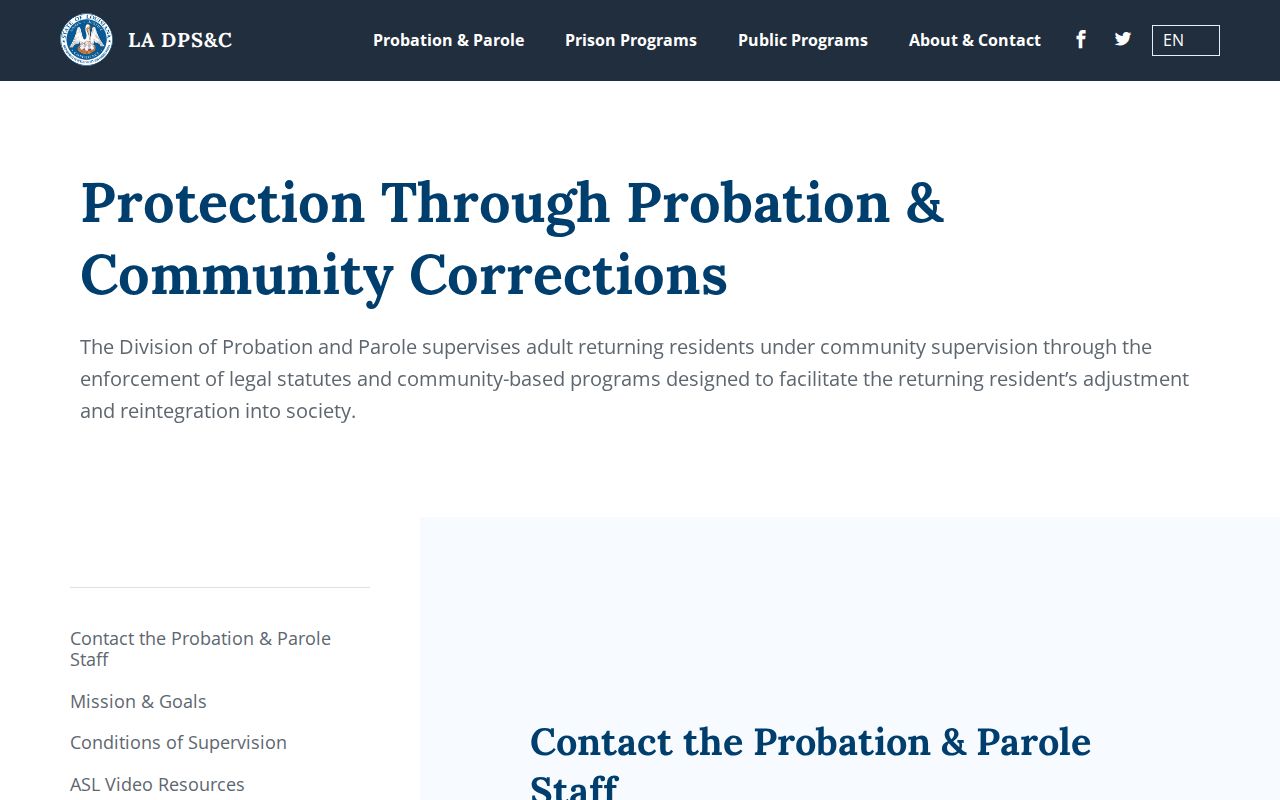
The official Probation and Community Corrections page explains statewide supervision and provides the office-directory path. Its image below shows the official source used for conditions and district information.
24 Accent Drive, Suite 101
Monroe, LA 71202
318-362-3171
For an urgent jail-status question, OCC uses a different route. Call OPSO jail information at 318-329-1200. A documented OCC booking or release record is handled through Records/Identification at 318-324-2630. Keeping these contacts separate prevents a supervision office from being asked to certify a local jail-door event it did not create.
Ouachita Supervision Rules and Violations
DPS&C publishes high-level supervision conditions. Its materials state that supervised people must report as ordered, with monthly reporting by the fifth among the listed conditions. Parole instructions also address the first report after release. The controlling terms still come from the person’s certificate, court judgment, and officer instructions. A general agency page cannot resolve an individual condition, fee, travel limit, or approved exception.
A violation allegation can change custody status. A Committee warrant or later revocation may return a person to confinement after an earlier valid release. “Absconder” generally describes an alleged failure to report or an unauthorized departure from supervision. It is not interchangeable with a conviction or a routine missed appointment. Because no official public general-name Ouachita absconder database was verified, use the supervising office, the court, and official warrant channels. The Sheriff app’s “most wanted” feature is not a parole or probation absconder list.
LAVNS can help track a current source record or custody-status event, but it is not a certified supervision file. Notifications may lag. They can also reflect one agency while another agency has a hold. Record the exact status, source agency, and query time, then ask the agency that created the record to confirm it.
Ouachita Parole Hearings and Discharge
The Louisiana Board of Pardons and Committee on Parole publishes its process, weekly dockets, and results. Hearings are open and conducted through Zoom with YouTube access. DPS&C says parole hearings are usually scheduled within nine months of eligibility, but a scheduled hearing is not a grant. A result may be granted, denied, deferred, rescinded, or otherwise labeled by the official record. Transcribe the actual result.
Eligibility is also not a projected discharge date. Louisiana R.S. 15:574.4 has date, offense, and conviction-specific branches. Its older general 25% branch applies to qualifying pre-August 1, 2024 offenses, while a cited crime-of-violence branch requires at least 65% when otherwise eligible. Other rules may change or remove eligibility. The weekly parole dockets and results provide the current person-specific path.
Supervision ends through an official discharge or sentence-completion record, not merely because a name stops appearing in a locator. For a probation case, check the court and P&P record. For parole, use the agency’s record of the remaining sentence and discharge. The broader Ouachita Parish released inmate search and record path explains how the local OCC release report fits beside those state and court records.
Note: A favorable parole decision may have conditions and an effective date that comes after the hearing result.
Ouachita Reentry Help After Release
A 2022 Justice Reinvestment Initiative report gives Ouachita Parish a useful local lead. It documents Monroe P&P reentry activity involving bus passes and Louisiana identification vouchers. The same report describes statewide reentry program managers. Those facts show that the Monroe District has taken part in release-planning work, but they do not promise that a pass, voucher, or program remains available to every person today.
Ask Monroe District what current help applies to the person’s status and release plan. The officer may also know which state or local reentry contact is appropriate. A request should be specific: ask whether identification, transit, reporting, or reentry coordination is offered now, what eligibility rules apply, and what proof is needed. Do not arrange travel based on an old report alone. Program funds, partners, and intake rules can change.
Ouachita Release ID and Property Questions
Identification and property are separate release tasks. The JRI report supports asking Monroe P&P about current Louisiana ID voucher help for a person entering supervision. It also supports asking about transit aid. The office should confirm present availability. A parole or probation status does not by itself establish that either form of help has been approved.
OPSO publishes no verified OCC property-return procedure, release exit, pickup schedule, or family waiting location. Call OCC at 318-329-1200 before traveling and ask what identification is needed, whether property remains at the jail, and which time and place staff direct for pickup. Do not assume Monroe P&P holds jail property. Likewise, an OCC answer about stored property does not establish whether the person is on parole or probation.
Note: Confirm ID aid with Monroe P&P and property pickup with OCC because the two offices hold different records.
Ouachita Parole Reporting After Release
Louisiana’s parolee instructions say a newly released parolee must report in person within 48 hours to the office shown on the parole certificate. They also say out-of-state travel requires permission. When an interstate transfer is pending, the parole officer provides the instructions. These are parole directions and should not be copied onto every probation case without checking the judgment and officer’s terms.
The certificate-listed office controls the first reporting destination. A Monroe address on a public directory is helpful, but the certificate may point elsewhere. If the record lists Monroe District, call 318-362-3171 and follow the official direction. A person leaving OCC on bond may have court conditions but no parole reporting duty. A state prisoner released under a different statutory status may have another framework. Read the release label first, then use the office tied to that label.