
Ouachita LAVNS and VINELink Coverage
Louisiana calls its service the Louisiana Automated Victim Notification System, or LAVNS, and delivers the public search through VINELink. DPS&C describes LAVNS as a 24-hour offender locator and publishes 866-528-6748. The phrase “24-hour” describes service availability, not instant data. The agency’s inmate-information page says LAVNS updates every 24 hours.
The system is a state-published locator and notification channel. It includes Louisiana imprisoned people and people under probation or parole. No primary coverage list proves that every OCC field or record appears in each search context. The separate Ouachita Sheriff app is the specifically verified local channel for a named booking or release alert. That distinction should remain clear when a particular OCC record is not found in LAVNS.
LAVNS does not absorb all custody systems. A federal prosecution calls for the Bureau of Prisons locator or U.S. Marshals records. Immigration custody, including a transfer to Richwood Correctional Center, calls for ICE’s Online Detainee Locator System. A person can leave OCC and enter another agency’s custody, so one valid release event may not mean community freedom.
Search One Ouachita Inmate on VINELink
Search one identified person, not a broad list. Open the Louisiana LAVNS portal, choose People search, and enter an exact name or an ID or case number. Narrow by agency or location only when the live interface offers that field. A common name may produce several records, and the right parish alone is not enough to select one.
The official search landing screen shown below is the subject-matched VINELink image captured for Ouachita Parish release checks.
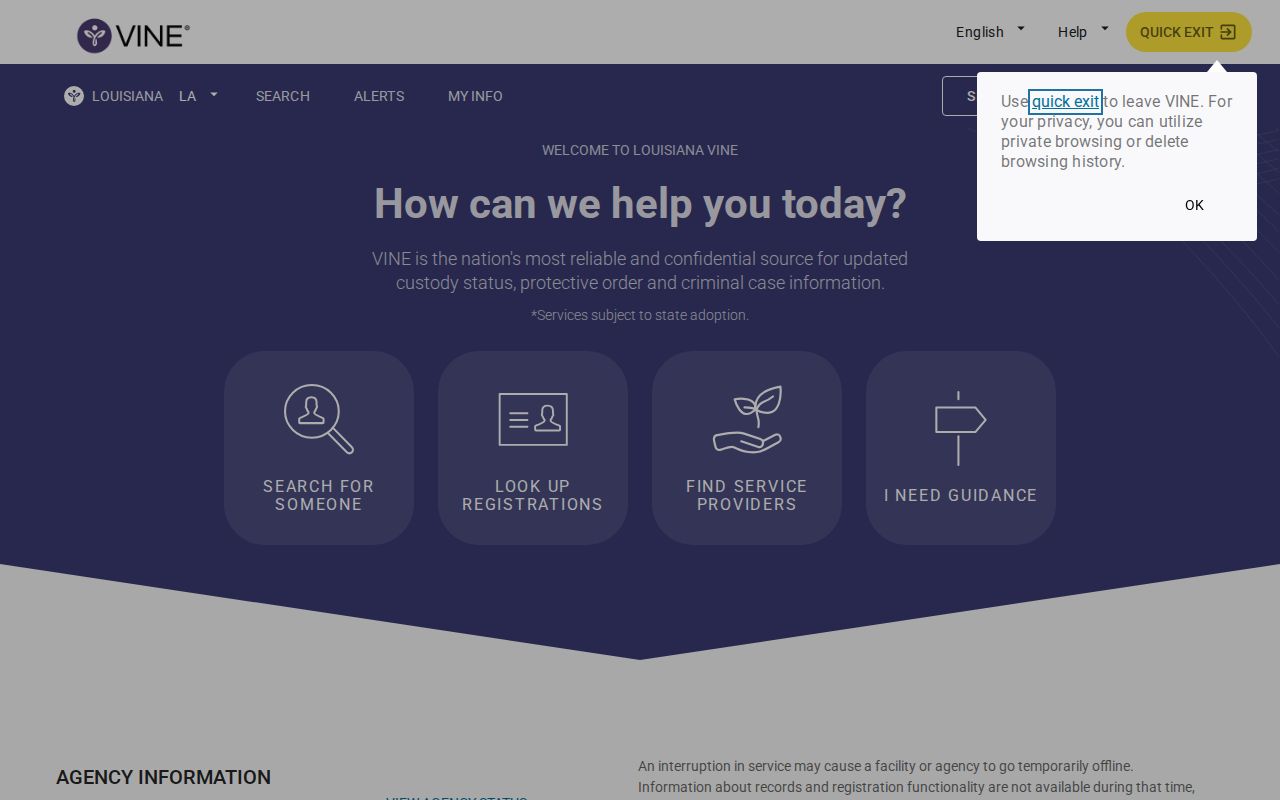
- Open Louisiana LAVNS and choose the People search option shown in the live portal.
- Enter the exact name or the known offender, ID, or case number.
- Use agency or location filters only if the current interface presents them.
- Compare available identifiers and do not choose a record from the name alone.
- Open the match and read the status, agency, and location words exactly as displayed.
- Record the date and time of the query, then confirm an OCC release through OPSO or court records.
When no record appears, check spelling, aliases, identifiers, update timing, and custody type. A fully discharged person may not persist forever. The state description does not promise a permanent public history. For a named person whose local custody has ended, the Ouachita Parish release-record search path explains the OCC report and court-record fallback.
Ouachita VINELink Release Record Fields
The exact fields and result labels must come from the live record. No official source proves every label for a released Ouachita person or shows that OCC appears in every possible search. That gap is a fact, not a reason to invent a schema. Use only what the current result displays, preserve the query time, and distinguish custody status from a formal release document.
| Live item | How to read it |
|---|---|
| Name and identifier | Use them to separate the intended person from a namesake. |
| Source agency | Shows which agency supplied the event or status being viewed. |
| Custody status | Transcribe the exact label without changing release, transfer, supervision, or inactivity into another term. |
| Facility or location | May point to confinement or a community-supervision district; identify the location type. |
| Event information | Treat the date and wording as a notification lead until the source agency confirms it. |
| Notification options | Use only the phone, text, or email choices actually shown for that record. |
A P&P district location can support a conclusion that the person moved into community supervision. It does not prove full discharge. Likewise, “not in custody,” “released,” transfer, parole, and inactive are not synonyms. A state projected date is also different from an actual OCC release time. Keep each agency’s wording attached to the record that supplied it.
Note: Save the displayed agency, status wording, identifier, and query time before seeking the source record.
Register Ouachita Release Notifications
Registration should occur while the correct person remains in the source system. An alert cannot always be created after a record has disappeared. From the matching record, select the notification-registration control and choose a delivery method that the interface actually offers. Louisiana materials support phone, text, or email as possible channels, but the exact choices may vary by record and current screen.
Legacy VINE phone registration uses a personal identification number to acknowledge calls and manage repeat notifications. Do not claim that text or email always uses the same PIN. Follow the displayed confirmation for the channel selected. Keep the PIN private. It should not appear in a public case note or a message sent to others.
- Open the correctly matched person record and select notification registration.
- Review the custody source before subscribing so a namesake alert is not created.
- Choose a phone, text, or email option only if the live record displays it.
- Enter a destination that can be checked often and that the subscriber controls.
- Create a phone PIN if requested, then complete the screen’s verification or confirmation.
- Preserve the event wording and delivery time when an alert arrives, then verify with the source agency.
The DPS&C Crime Victims Services Bureau also has a direct victim-registration process. That agency route is separate from self-service VINELink registration. One should not be described as the other. For help with Louisiana’s service, use the official LAVNS number or the state victim-services channel.
Ouachita Sheriff Release Alert Channel
Ouachita has a local notification layer in addition to the statewide service. The official Sheriff app listing states that a user can create an alert by name and/or date of birth and receive a push notice when the named person is booked or released from OCC. OPSO’s bookings gateway currently routes users toward that app while the web bookings page is being reconfigured.
The local app is an individual alert channel. It is not a verified browsable release archive, and its listing does not establish a release-reason field, photo, retention window, or downloadable proof. A push notice can support the event trail, but OPSO Records remains the documented route for the booking sheet or release report. Contact Records/Identification at 318-324-2630 for the record path, or call OCC jail information at 318-329-1200 for an urgent current-status question.
The two alert systems also have different proof limits. A Sheriff app notice reflects the local feature described by OPSO, while a LAVNS notice reflects the person and agency record selected in the state service. Neither notice states that all other holds have ended. When an alert reports an OCC release, ask whether the release was to the community or a transfer. If the destination is a DPS&C facility, another jail, Richwood, or a federal authority, continue the check in that system and retain the first notice as one part of the event trail.
Using both channels can help when they serve the same person. Register in advance, keep the name and date of birth accurate, and compare any event wording with the source agency. Do not infer that a missing notice means no release occurred. A registration error, device setting, timing gap, or agency correction can affect delivery.
Confirm Ouachita VINELink Release Events
A release alert is valuable because it records a status event tied to a person and source agency. It is not a certified release report. Delivery may lag, a call may be missed, or the source agency may correct its data. Preserve the sender, delivery time, person identifier, agency, and exact wording. Then ask the agency that supplied the status for the underlying record.
For OCC, request the booking sheet and release report with the actual release date and time, release type, legal authority, and destination or transfer agency if releasable. Court minutes from the correct Ouachita court can explain the order or disposition, but they are not the jail-door timestamp. If the record shows transfer to DPS&C, another jail, ICE, BOP, or USMS, move to that receiving system.
A current jail roster serves a narrower purpose. Presence supports current display at the time searched. Absence only means the person is not displayed there at that moment. It cannot distinguish bond, sentence end, transfer, a data change, or another hold. LAVNS, the Sheriff app, the release report, court minutes, and the receiving system answer different parts of the same chain.
Ouachita VINELink Limits by Custody
Choose the locator by legal custody. LAVNS is the Louisiana state route. OCC’s local report covers the parish jail episode. BOP’s locator covers federal prison records, while USMS records may be needed for federal pretrial movement. ICE ODLS covers current detainees and, under ICE guidance, people released from ICE custody within the prior 60 days. Juvenile records at Swanson Center for Youth are restricted and should be handled by an authorized family member, counsel, OJJ, or the responsible juvenile court.
The sex-offender registry has another narrow role. It covers people who have a legal duty to register, not released people as a class. A registry result may support identity or registration status, but it cannot establish an OCC release date. No official general Ouachita released-offender registry or public statewide P&P absconder name search was verified.
When a search fails, do not keep forcing the same channel. Check the name and identifier, identify the custody authority, and use the source agency’s records route. That method respects the line between notification, present custody, physical release, court disposition, transfer, and supervision.
Note: One agency can report release correctly while a receiving agency continues custody under a different legal authority.