
Ouachita Projected and Actual Release Dates
“Projected release date” is the exact term DPS&C uses for the estimate its phone locator may provide when applicable. The calculation can reflect the imposed sentence, received documents, jail credit, the offense-date cohort, eligibility rules, and earned or forfeited credit. It can change. An actual release date and time records when a specific facility relinquished its custody episode. The two dates answer different questions.
A person held at OCC before trial usually has no sentence-based projected date. Bond, dismissal, a court order, or another legal event controls that release. A parish-sentenced person may have a local computation. A DPS&C prisoner physically housed at OCC remains governed by the state master prison record for the state sentence. If OCC transfers that prisoner, its local release report and the continuing state sentence can both be correct.
- Projected release date
- The agency’s current forward-looking estimate after applying its sentence calculation.
- Actual release date
- The recorded date a facility ended the custody episode at issue.
- Parole eligibility date
- The first date an eligible person may be considered, not an approved release date.
- Full-term date
- The sentence endpoint described by the record’s own label and governing law.
- Supervision end date
- The date the community-supervision portion is scheduled or recorded to end.
Find an Ouachita Projected Release Date
Begin with legal custody, not the building name. OCC holds pretrial detainees, parish-sentenced people, and some DPS&C prisoners. The correct date source changes with that authority. For a state sentence, DPS&C directs the public to its inmate-information page and phone service. For a local sentence, use OCC or the authorized records route plus the court commitment. A federal or immigration case requires its own agency.
The Ouachita Parish released inmate search and records route helps identify the custody source before a projected-date inquiry begins. That first step prevents a local bond release, state sentence, federal hold, or immigration transfer from being forced into the wrong calculation system.
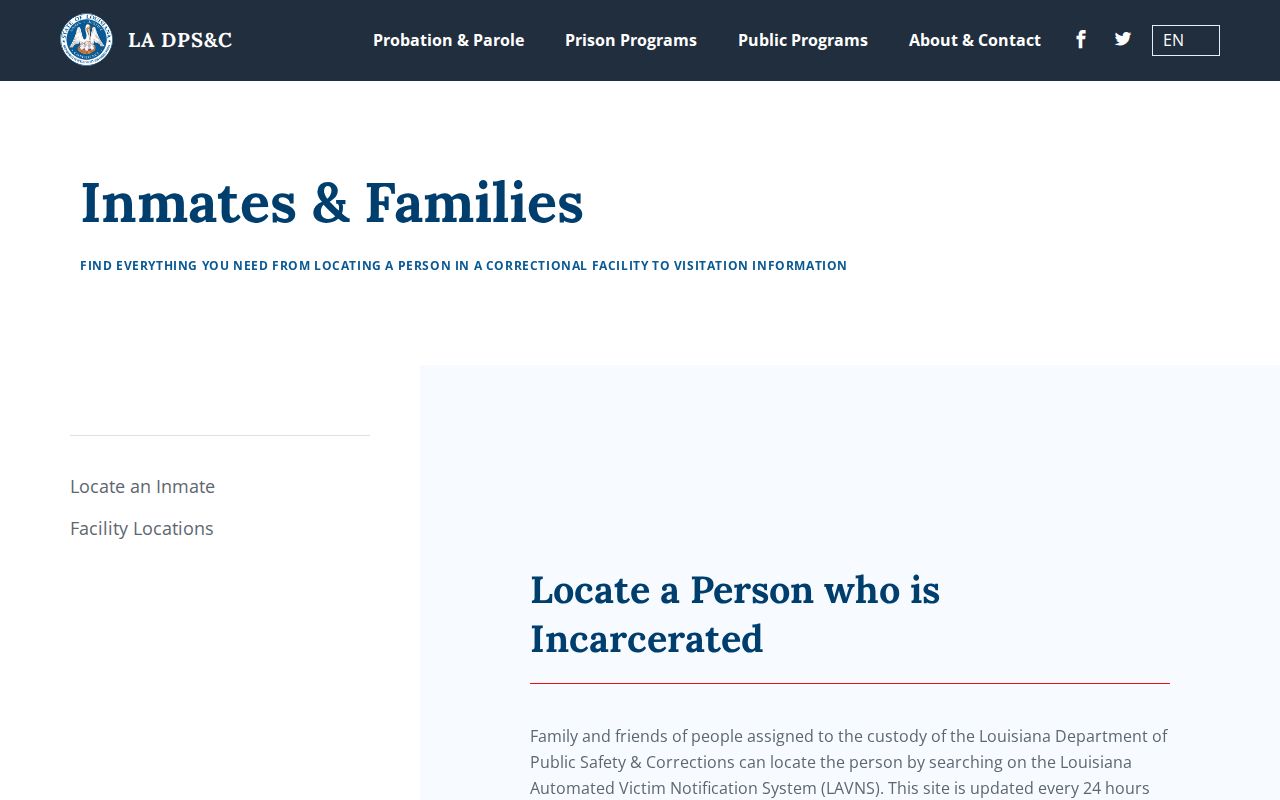
The DPS&C inmate-information page says the phone locator can provide a projected release date if applicable. The subject-matched image below captures that official date and search source.
- Determine whether the person is pretrial, parish-sentenced, under a DPS&C sentence, federal, or in immigration custody.
- For a DPS&C case, call 225-383-4580 with the DPS&C number or the person’s name and date of birth.
- Record the exact phrase “projected release date,” the query date, and the facility or P&P district supplied.
- If no state date is available, ask whether sentence computation is incomplete because required paperwork has not arrived.
- For a local OCC sentence, ask OCC or authorized records staff for the operative calculation and compare it with the court commitment.
- After the event, obtain the release report or receiving-agency record rather than treating the old estimate as proof.
Time-computation questions for a state sentence go to 225-342-0799. A state-facility prisoner seeking the formal calculation uses the facility Records Office. A locally housed state prisoner uses the DPS&C administrative remedy procedure identified by the agency. The general public-records mailbox does not replace those calculation routes.
Ouachita Release Date Record Sources
One record rarely answers every date question. The master prison record is the core state sentence-computation document. It may reflect the sentence, credits, projected date, and recalculations. An OCC release report focuses on the local physical custody event. The court file supplies the judgment, sentence, credits ordered by the court, and later case events. A parole docket shows consideration or a result, not the jail-door time.
| Source | Useful date or fact | Key limit |
|---|---|---|
| DPS&C phone locator | Projected release date, if applicable, plus facility or P&P district | No date may be available while computation is incomplete |
| State master prison record | Sentence computation, credits, and date changes | Nonpublic material may be withheld |
| OCC release report | Actual end of the local custody episode | Does not by itself end a state or receiving-agency hold |
| Ouachita court record | Judgment, sentence, disposition, and later orders | Not a physical release timestamp |
| Parole docket or result | Hearing schedule and official decision label | Eligibility or a grant may precede effective release |
| LAVNS | Current status and notification convenience | Updates daily and is not a permanent certified record |
The state public-information framework also matters. DPS&C identifies limited public imprisoned-person information under R.S. 15:574.12, including age, offense, conviction date, sentence length, and misconduct while incarcerated. A request may ask for public release and computation facts, but it should expect protected parts of the full offender file to be withheld.
Note: Reproduce the agency’s date label because projected, eligibility, hearing, full-term, and supervision dates are not interchangeable.
Modern Ouachita Good-Time Release Rules
For felony offenses committed on or after August 1, 2024, Louisiana R.S. 15:571.3.1 creates the central modern good-time rule. Eligible parish and DPS&C prisoners may earn diminution of sentence up to 15% of the imposed sentence. That creates an 85% floor for the particular sentence only after eligibility and exclusions are applied. It is not a universal promise that every person serves exactly 85%.
The statute’s basic earning rule excludes sex offenses as defined there and habitual offenders, and it contains added limits and procedures. It says no pre-sentence credit under that section, while sentencing credit and other law must still be read together. Credit may be forfeited. Consecutive terms, split sentences, revocation, and offense-specific rules can also change the full computation.
Release under this modern good-time mechanism generally occurs on unsupervised parole for the balance of the full term. The statute also addresses split-sentence probation. “Unsupervised” does not mean the sentence ceased to exist on the institutional release day. It describes the legal release status for the remaining term. The master record, not a percentage typed into a calculator, establishes the person-specific result.
Older Ouachita Good-Time Release Cohorts
Older offenses fall under different branches of R.S. 15:571.3. Eligible parish prisoners historically could earn 30 days of credit for 30 days served. A first crime of violence had a 3-for-17 rate. Eligible older DPS&C felony cohorts include a 13-for-7 rate with exclusions. These are separate cohorts, not three options that a person may choose.
Offense date, prior convictions, crime-of-violence classification, sex-offense status, habitual-offender treatment, hard-labor status, revocation date, and other exclusions can control which branch applies. Never use a modern 15% cap for an older offense without authority. Never carry an older 30-for-30, 3-for-17, or 13-for-7 rate into a post-August 2024 case merely because it gives an earlier estimate.
R.S. 15:571.5 describes certain older good-time release as if released on parole for the balance of the full term. Thus, community presence may coexist with a remaining legal sentence and a revocation framework. That is not the same as full discharge. P&P information and the master prison record supply the needed distinction.
Ouachita Parole Dates Are Separate
Parole eligibility is not the projected release date. For qualifying offenses committed before August 1, 2024, R.S. 15:574.4 contains an older general branch at 25%. Its cited crime-of-violence branch requires at least 65% when otherwise eligible. Other branches include 75% for specified second-violence or first or second sex-offense cases, while specified later convictions can be ineligible, subject to the statute’s exceptions.
Post-August 2024 cases do not simply inherit the old general 25% rule. Parole may be unavailable or restricted unless another law creates eligibility, such as a special juvenile or medical route. Even where a threshold is met, eligibility allows consideration. It does not compel release. The Committee may deny the request, set later review, or impose conditions.
A hearing date and a grant can each precede the effective release. Use the weekly docket and official result, then verify the later custody event. If the state locator later shows a Monroe P&P assignment, that may support a transition into community supervision. It still does not replace the decision record or actual release report.
Why Ouachita Release Dates Change
A projected date is a calculation made from the information then available. It can move later or earlier as lawful inputs change. Record the inquiry date every time a projected date is obtained. A number written down weeks ago may no longer match the operative state or local computation.
| Change | Possible effect | Best confirmation |
|---|---|---|
| Missing or corrected sentence papers | A date may be absent or recalculated | DPS&C time computation and sentencing court |
| Authorized credit posted | The date may move earlier | Master record or authorized OCC calculation |
| Credit forfeiture or discipline | The date may move later | Responsible records or computation office |
| New sentence or court order | The term or credit can change | Court record and updated agency calculation |
| Detainer or another hold | One custody may end while another begins | Release report and receiving agency |
| Parole decision or revocation | Release timing or custody status may change | Committee result, P&P, and custody record |
If a projected date has passed while the person still appears confined, check whether the old label was an eligibility date, whether a detainer exists, and whether the calculation changed. If a name vanishes before the estimate, check transfer and data lag before assuming early community release.
Note: A transfer can end the OCC episode while the state, federal, immigration, or other local custody continues.
OCC Ouachita Release Calculation Boundary
R.S. 15:571.3 assigns eligible parish-prison good-time authority to the sheriff, or to a superintendent when the facility is not sheriff-operated, under law and regulations. OCC’s public pages do not publish a calculation worksheet, an independent local good-time policy, or a special weekend, holiday, or Friday-release rule. A rule from another parish or state cannot fill that gap.
For a short parish sentence, ask OCC or the authorized records staff for the actual computation and inspect the court commitment. For a DPS&C prisoner housed at OCC, the state master prison record controls the state sentence even though OCC documents departure from its building. For a person who bonded out before trial, percentage-based good time is usually the wrong question. The bond or court authority and OCC release report are the relevant records.
Call OCC jail information at 318-329-1200 for the local custody route. For state computation questions use 225-342-0799. A pending event may also be followed through the Ouachita Parish VINELink release check, but the alert should be confirmed with the agency record after it arrives.